Headlines about “de-dollarization” can make it sound as though the world is rapidly abandoning the US dollar. Central banks are buying gold, countries are experimenting with local-currency trade, and the dollar’s share of foreign-exchange reserves is lower than it was two decades ago.
Those developments are real. But they do not tell the whole story.
A currency can dominate in several different ways: as a central-bank reserve, as the currency used to price trade, as a funding currency for banks and companies, as a payment currency and as the currency most heavily traded in foreign-exchange markets. Look across all of those measures and the conclusion is more restrained: the dollar is gradually losing ground in some areas, but there is little evidence that it is close to losing its position as the world’s leading international currency.

The Short Answer: Erosion, Not Collapse
The strongest evidence of de-dollarization appears in official foreign-exchange reserves.
IMF data show the US dollar accounted for 56.77% of global foreign-exchange reserves in the fourth quarter of 2025, compared with roughly 72% at its 2001 peak. The euro held about 20.25%, while the Chinese renminbi accounted for only 1.95%.
That is a meaningful long-term decline.
Yet other measures look very different. The dollar was on one side of 89.2% of global foreign-exchange trades in April 2025, slightly higher than its 88.4% share in the 2022 BIS survey. Because every FX trade contains two currencies, currency shares in this measure add to 200%, not 100%.
SWIFT data tell a similar story. In July 2026, the dollar represented 50.99% of payments by value on SWIFT globally, rising to 59.58% for international payments when payments within the eurozone are excluded. The renminbi’s corresponding global payment share was 3.10%.
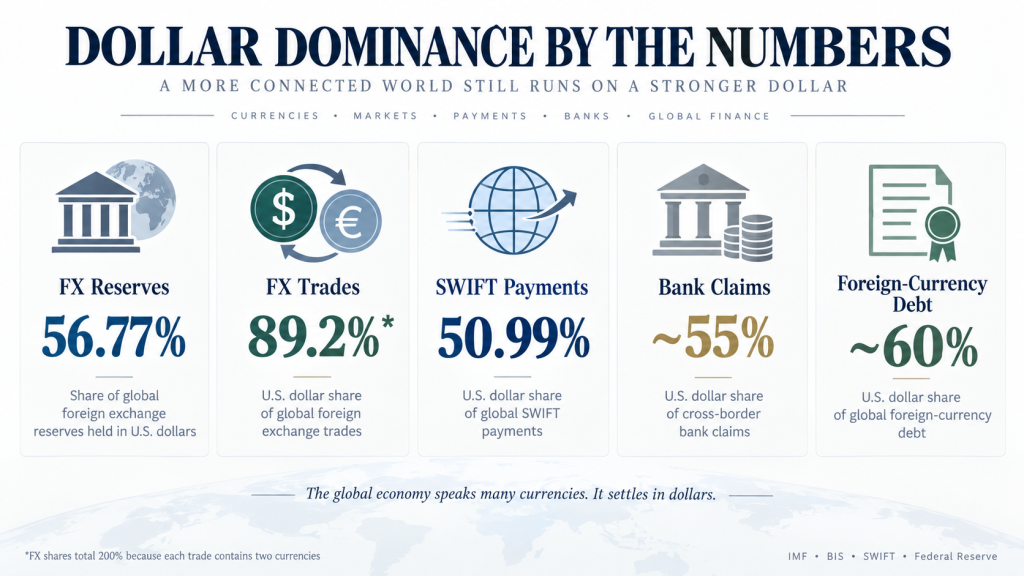
Dollar Dominance by the Numbers
| Measure | Latest available reading | What it suggests |
|---|---|---|
| Global FX reserves | 56.77% USD, Q4 2025 | Long-term decline, but still No. 1 by a wide margin |
| Global FX trading | 89.2% involved USD, Apr. 2025 | Dollar remains overwhelmingly dominant |
| SWIFT global payments | 50.99%, Jul. 2026 | Dollar leads international payments |
| International/foreign-currency banking claims | About 55%, 2024 | Strong dollar-based financial system |
| International/foreign-currency banking liabilities | About 60%, 2024 | Dollar remains central to bank funding |
| Foreign-currency debt issuance | Around 60%, 2024 | Companies still heavily borrow in dollars |
The banking and debt figures come from Federal Reserve analysis using BIS and market data.
Where De-Dollarization Is Actually Happening
Reserve diversification is real.
IMF research has found that central banks have gradually shifted part of their portfolios away from dollars into a wider range of currencies. Crucially, the beneficiaries have not simply been the euro or Chinese renminbi. Australian and Canadian dollars and other smaller reserve currencies have also gained ground.
Gold has become more prominent too. Federal Reserve analysis found that gold’s market-value share of official reserves had risen from below 10% in 2015 to more than 23% by 2025, although much of that rise reflected the increase in gold prices rather than an equally dramatic increase in the physical amount of gold owned by central banks.
There is another complication: exchange rates themselves can make the dollar’s reported reserve share appear to change.
In the second quarter of 2025, for example, the headline dollar share fell sharply. But IMF calculations showed that 92% of that quarterly decline was caused by currency valuation effects. At constant exchange rates, the reduction was much smaller.
That is why a single quarterly reserve number is a poor measure of whether the world’s monetary order is changing.
Why the Dollar Remains So Difficult to Replace
The biggest advantage of the dollar is not simply the size of the US economy. It is the infrastructure built around the currency.
Banks lend dollars. Companies issue dollar bonds. Commodities and international contracts are frequently priced in dollars. Investors hedge currency risk through deep dollar markets, while central banks can hold enormous quantities of liquid US Treasury securities.
The Federal Reserve estimates that about 55% of international and foreign-currency banking claims and 60% of corresponding liabilities are dollar-denominated. Dollar-denominated foreign-currency debt issuance has also remained around 60% since 2010.
This creates a powerful network effect. If your suppliers, lenders, investors and trading partners already use dollars, adopting another currency introduces additional conversion, hedging and liquidity costs.
The scale of the Treasury market matters as well. Foreign investors held about $9 trillion of marketable US Treasury securities in the first quarter of 2025.
A rival reserve currency therefore needs more than international political support. It also needs large quantities of liquid, trusted assets and financial markets that investors can enter and exit easily.
Can the Euro, Yuan or BRICS Currencies Challenge the Dollar?
The euro is the closest traditional alternative, holding roughly one-fifth of global foreign-exchange reserves. Deeper European capital markets and a larger supply of jointly backed European debt could eventually make it more attractive internationally.
China presents a different case. Its economic and trading scale gives the renminbi obvious potential, and its use in some international transactions has expanded.
But the currency still represents only about 2% of global reserves. The Federal Reserve points to restrictions on convertibility, China’s relatively closed capital account and institutional concerns as significant barriers to much wider international adoption.
Local-currency trade among BRICS members and other emerging economies can reduce dollar usage in particular transactions. That matters at the margin. But settling one bilateral trade flow in local currencies is very different from replacing the dollar across reserves, banking, bond markets, derivatives, commodity pricing and global FX liquidity.
What Could Seriously Weaken Dollar Dominance?
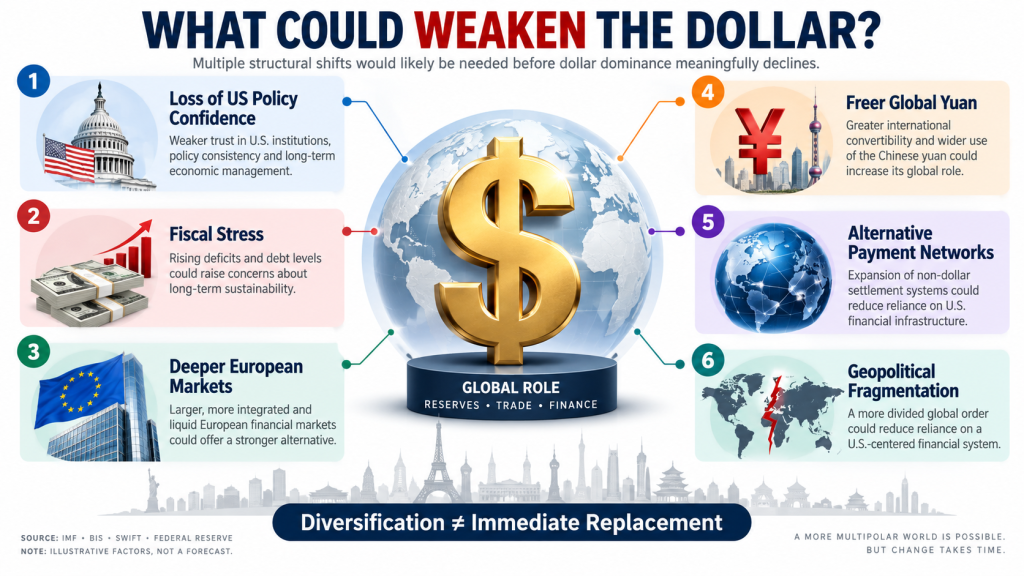
The more useful question is not whether countries can conduct individual transactions without dollars—they clearly can—but what could undermine the wider dollar ecosystem.
Several developments would matter:
- a sustained loss of confidence in US economic or institutional stability;
- serious concerns over US fiscal sustainability;
- greater geopolitical fragmentation and sanctions-related reserve diversification;
- a much deeper and more unified European capital market;
- substantially greater renminbi convertibility and financial-market openness;
- or a new payments technology that becomes global without remaining anchored to the dollar.
Digital finance could cut both ways. Instead of weakening the dollar, dollar-backed stablecoins have so far extended it into crypto markets. Federal Reserve research noted that roughly 99% of stablecoin market capitalization was dollar-linked in the data it examined.
Why “The Dollar Is Finished” Is the Wrong Framework
The evidence supports neither extreme.
It is inaccurate to say nothing is changing: the dollar’s reserve share has clearly fallen over the long term, central banks are diversifying, and alternative payment arrangements are expanding.
But it is equally difficult to reconcile claims of an imminent dollar collapse with a currency involved in roughly nine out of ten FX trades, around half of SWIFT payment value, and most international dollar-style banking and foreign-currency debt activity.
The emerging system may therefore become more multipolar without becoming post-dollar.
Key Takeaways
- The dollar’s global reserve share has fallen from around 72% in 2001 to 56.77% in Q4 2025.
- Reserve diversification is genuine, but the money leaving dollars is not flowing into one clear replacement currency.
- The dollar was still involved in 89.2% of global FX trades in the 2025 BIS survey.
- It accounted for 50.99% of SWIFT global payment value in July 2026.
- The renminbi is becoming more internationally relevant, but its roughly 2% reserve share remains small.
- The most plausible near-term outcome is gradual diversification rather than an abrupt end to dollar dominance.
Frequently Asked Questions
Is the US dollar losing its reserve currency status?
Not in the sense of suddenly being replaced. Its share of global foreign-exchange reserves has fallen substantially over the past two decades, reaching 56.77% in Q4 2025, but it remains far ahead of the euro and renminbi.
What currency could replace the US dollar?
There is no obvious single replacement today. The euro has the second-largest reserve share, while China’s renminbi has economic scale behind it but remains constrained by limited convertibility and a relatively closed capital account. A more fragmented system involving several currencies is more plausible than a rapid one-for-one replacement.
Is BRICS creating de-dollarization?
BRICS countries and other emerging economies can reduce dollar dependence by settling more trade in local currencies or developing alternative payment channels. That can weaken dollar usage in particular corridors, but it does not automatically replace the much larger dollar ecosystem in reserves, global banking, FX trading and international debt markets.
How much of global reserves are held in US dollars?
According to the IMF’s latest available COFER data, US dollars represented 56.77% of global foreign-exchange reserves in Q4 2025. The euro’s share was 20.25%, while the Chinese renminbi accounted for 1.95%.
Is the Chinese yuan becoming a global currency?
Yes, but from a relatively low base. The renminbi is used in international payments and trade finance and has gained importance in some bilateral trade relationships. However, it represented only 1.95% of official global FX reserves at the end of 2025 and 3.10% of global SWIFT payment value in July 2026.
Would countries buying more gold hurt the dollar?
It can reduce reliance on foreign currencies in some central-bank portfolios, particularly where geopolitical risk matters. However, rising gold reserve values do not automatically represent dollar selling because much of the increase can come from higher gold prices.
Could the dollar lose dominance quickly?
A rapid shift would probably require both a major loss of confidence in US assets and the emergence of a credible alternative with deep financial markets, freely movable capital and enough safe assets to absorb global demand. Current data show gradual diversification rather than that kind of systemic replacement.
The dollar is no longer as dominant in central-bank reserves as it was at the start of the century. That trend deserves attention.
But the strongest conclusion from the broader data is not that the dollar is disappearing. It is that the international monetary system is slowly becoming more diversified while the dollar remains at the centre of its deepest financial markets.
For readers following de-dollarization, the best approach is therefore to watch several indicators together—reserves, FX turnover, payments, international lending and debt issuance—rather than treating any single BRICS agreement, gold purchase or quarterly reserve move as proof that the dollar era has ended.